
Happy Wednesday FACNM community,
Although we aren’t seeing much smoke in the air this fall due to abnormally wet weather, and the risk of high-severity wildfire has been temporarily superseded by the risk of severe flooding, the work of laying the groundwork for prescribed fire in New Mexico never ends. Prescribed fire continues to be the most effective method for reducing hazardous fuels and improving forest and range health and resilience at a landscape-scale.
In today’s Wildfire Wednesday, we delve into the prescribed fire environment in New Mexico through an interview with the New Mexico Prescribed Fire Council Vice-Chair Sarah DeMay.
This Wildfire Wednesday features:
What are Prescribed Fire Councils and Prescribed Burn Associations?
Sarah DeMay on the NM Prescribed Fire Council’s Mission and Projects
Additional Resources and Upcoming Events
Wildfire Resiliency Training Center fall class schedule
Research: Wildfire suppression costs will continue to increase
Nov. 12 Panel: Wildfire Solutions and Answers
Nov. 7 Event: Wild Rivers Fire Ecology Day
Nov. 19 Event: Film screening of burn, scar
Be well,
Maya
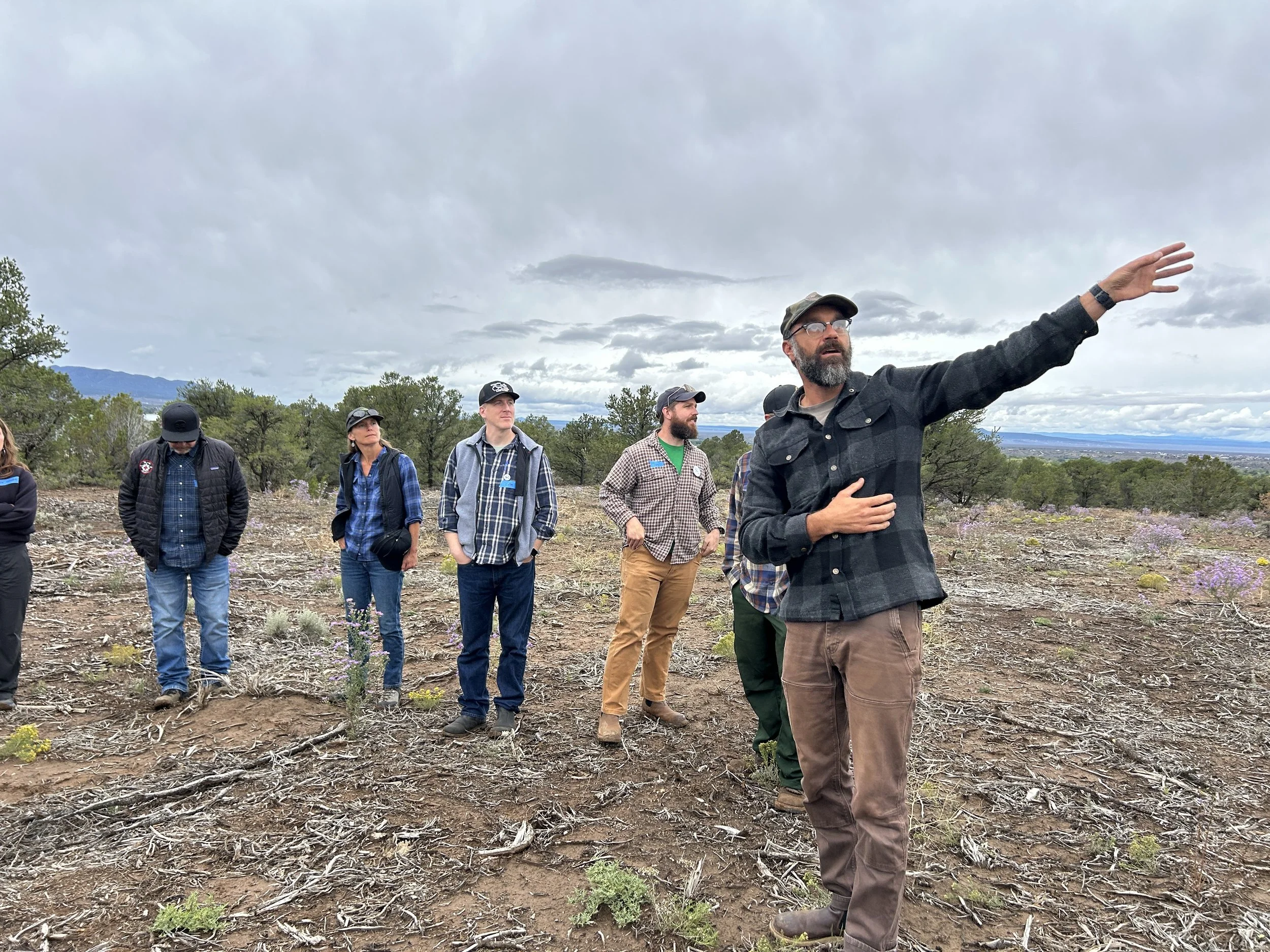
New Mexico Prescribed Fire Council members discuss forest treatments during a field meeting in fall 2026.
What are Prescribed Fire Councils and Prescribed Burn Associations?
Learn about Prescribed Fire Councils.
Prescribed Fire Councils, which generally exist at the state or regional level, tackle barriers to the expanded use of prescribed fire on both public and private lands. They may do this through public outreach, partner education, trainings, resource sharing, policy advocacy, and/or modeling collaborative burning.
Learn about Prescribed Burn Associations.
Prescribed Burn Associations (PBAs) are groups of landowners who pool their knowledge and resources – and may work with local partners – to help conduct prescribed burns on each other’s lands.
Formal and informal PBAs exist across the country. They often provide their members with peer-to-peer mentorship and training to gain the skills to conduct their own burns.
New Mexico does not have any formal PBAs, but (as described below) the New Mexico Prescribed Fire Council is working on creating the enabling conditions for PBAs where they may be useful.
The New Mexico Prescribed Fire Council's Mission and Projects: An Interview with Sarah DeMay
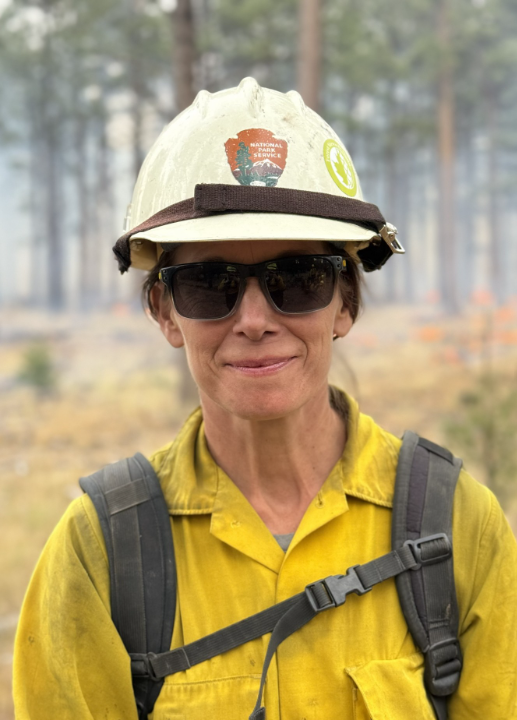
The following interview with New Mexico Prescribed Fire Council Vice-Chair Sarah DeMay (photo at right) has been edited for brevity. Sarah wears many hats including those of an experienced wildland firefighter, a prescribed fire practitioner, a landowner in a burned area, and a dedicated advocate for healthy forests and watersheds across the state.
What is the mission and audience of the New Mexico Prescribed Fire Council?
The New Mexico Prescribed Fire Council has been around for about 15 years. The mission is to support safe and effective prescribed fire on all lands in New Mexico – mostly through outreach, education and training.
A lot of what we do is based on the power of collaboration. The Council is an acknowledgement of the fact that if we’re going to move the needle and burn more quality acres and change the culture and social factors around prescribed fire in New Mexico, we all have to be at the table.
The Council is coordinated by a highly collaborative group of prescribed fire practitioners and professionals with representation from the US Forest Service, the Natural Resources Conservation Service (NRCS), the NM Forestry Division, Soil and Water Conservation Districts, the National Forest Foundation, the University of New Mexico, the Quivira Coalition, the Forest Stewards Guild, The Nature Conservancy, and the New Mexico Forest and Watershed Restoration Institute.
The Council is not just for practitioners of prescribed fire: It’s open to anyone who works to support prescribed fire on all lands.
We have monthly meetings, and we have collective momentum. We really think we can do something good with this entity.
What projects or initiatives has the New Mexico Prescribed Fire Council worked on?
The Council was one of the main drivers for the Prescribed Fire Act passed in 2021, which gives people the right to burn in New Mexico and is also intended to provide training, facilitate burn permitting, and overall make it more feasible for people to burn on private lands (which is a big piece of the puzzle!). Editor’s note: Almost one-third of forests and woodlands in New Mexico — over 7 million acres — are privately owned!
The Prescribed Fire Act passed in the legislative session just before the Hermit’s Peak/Calf Canyon Fire, which of course was a big challenge because that fire started from escaped burns. The legislative session after the fire, we went back and reaffirmed support for the Act. That’s been a big deal.
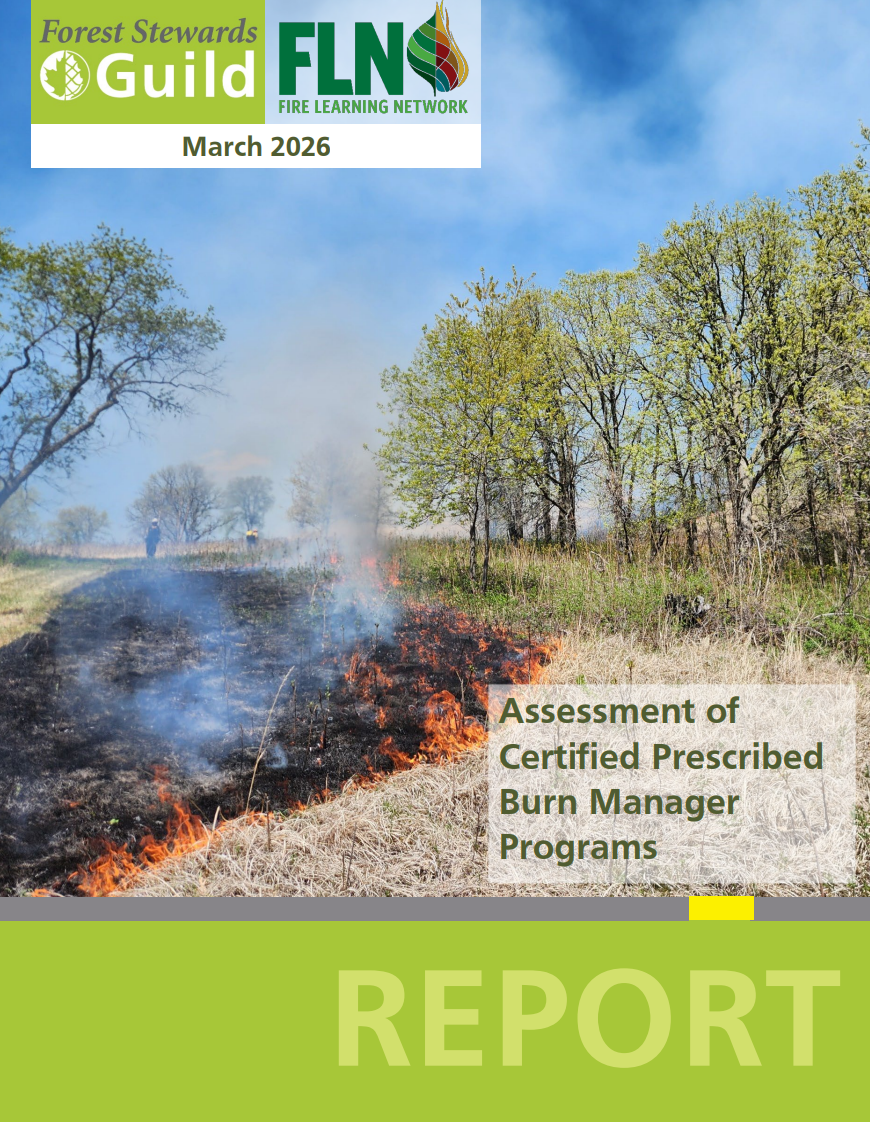
Learn more about Certified Prescribed Burn Manager Programs across the U.S. (including New Mexico) from this 2026 report.
We’re still trying to support the State in the rollout of the Prescribed Fire Act, specifically to work towards getting people certified as Prescribed Burn Managers. The Certified Burn Manager Program is really still in development, but the main reason I still work on it is because I truly believe that this program has the potential to create real, positive change for New Mexicans who are willing to take a proactive role in the protection and health of both their own lands and the landscape as a whole.
Initially, the flagship benefit of the Certified Burn Manager Program was to reduce liability for landowners in the event of an escape if they’re certified. But the way that I’ve found it most useful is helping people actually work with local fire chiefs to get a burn permit and build that trust locally.
Watch this 2023 webinar for more information about the Certified Burn Manager Program, steps to become certified, and benefits of the program.
The Certified Burn Manager Program can also help make burning more affordable for landowners because you can manage your own burn without having to pay someone to do it. So, we [at New Mexico Prescribed Fire Council] are also working to help facilitate burn manager trainings by finding opportunities on private lands to bring people in to learn how to burn and go through the training with the state.
Anything else the Council hopes to work on in the next few years?
The Council has always had great ideas and good intentions, but we’ve had limited time to get ideas across the finish line because it’s all been people just trying to find extra time to engage. But, our past chair Gwen Kolb and current vice-chair Eytan Krasilovsky secured us a Forest Service grant that is helping us actually move the needle on some projects.
One of the Council’s main tasks under the grant is to help federal partners like the Forest Service with outreach for adjacent landowners and in-holders about potential prescribed fire projects, especially if we can develop Wyden authority agreements for cross-boundary prescribed fire. (A Wyden authority agreement is an agreement between the Forest Service and a private landowner that allows the Forest Service to actually manage a burn across the boundary onto private land.)
When we talk to Forest Management Officers, the number one thing they say they need help with is outreach with communities and adjacent landowners. Forests need to be able to burn adjacent to private lands and across boundaries because that's the most important thing we can do to protect communities.
When the Forest Service has to stop burns at fencelines, that requires a whole lot of extra work and is less effective, whereas when the Forest Service can use existing landscape features and not have to do all this invasive extra work, that’s better for everyone. Then the landowner also gets a really beneficial fuel treatment on their land, and when the fire moves through there, the fire will have a lower severity on both the Forest Service and the private land.
Another priority for the Council right now is to support development of Prescribed Burn Associations (PBAs) through education, training, outreach, and microgrants. PBAs can help landowners and communities burn more safely and affordably, especially within the Wildland Urban Interface.
It always comes back to making connections. This is very collaborative work!
Questions for Sarah? Reach out to coordinator(at)nmrxfirecouncil.org.
Additional Resources and Upcoming Events
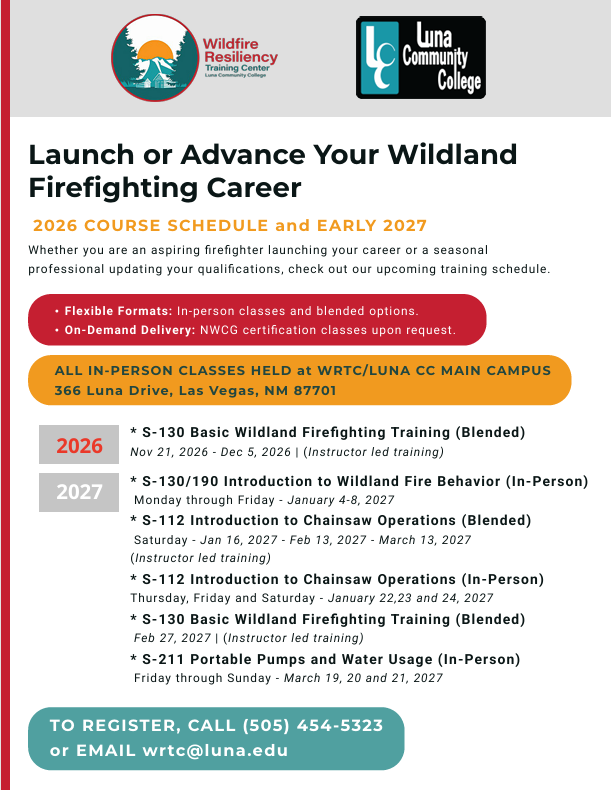
RELEASE: Wildfire Resiliency Training Center Fall 2026-2027 Schedule
If you are looking to launch or advance your wildland firefighting career, the Wildfire Resiliency Training Center (WRTC) at Luna Community College has finalized their class schedule for Fall 2026 - Winter 2027. Classes include S-130, S-112, S-211 and more. To register, call (505) 454-5323 or email wrtc@luna.edu.
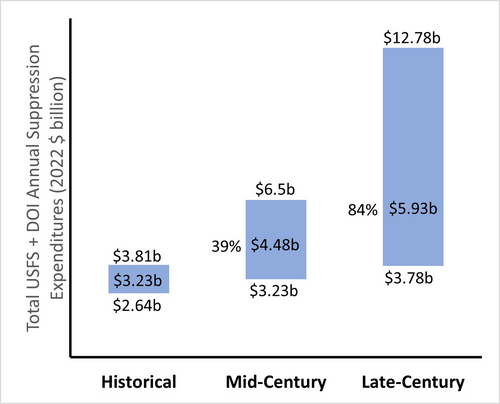
Projected real median annual expenditures, USDA Forest Service + the Department of the Interior, projected historical (2013–2019), projected Mid-Century (2041–2059), and projected Late Century (2081–2099), and 80% upper and lower bounds, in billions of constant FY 2022 dollars, and percentage increases by Mid-Century and Late-Century relative to the historical median annual expenditures. The Historical average shown are model-based predictions.
Suppression spending by the two main US land management agencies, the US Department of Agriculture's Forest Service and the Department of the Interior (DOI), has been rising in inflation-adjusted terms over the past three decades. Much of this rise can be traced to increasingly fire-prone weather and climate conditions becoming more common and widespread over time. Researchers sought to understand how changes in the rates of such conditions, as projected by multiple global climate models, would translate into wildfire suppression spending implications for both agencies. New research develops statistical models that link driving factors of wildfire and spending and then apply projections of future changes in those factors to anticipate changes in wildfire on federal lands and associated suppression spending. Researchers found that projected wildfire and spending trends to 2100 vary widely across scenarios but are universally upward. When summarized across all ten climate scenarios, suppression spending rises by a median rate of about 0.87% per year for the USFS and 0.65% per year for the DOI. By the end of the century, the cost of suppressing wildfires is likely to increase significantly. Read more: Wildfire, Suppression, and Federal Spending, 2020–2100 - Prestemon - 2026 - Earth's Future - Wiley Online Library
Join the Los Alamos City Fire Department and Jacobs Family Insurance for a wildfire expert panel discussion with speakers from the Insurance Institute of Business and Home Safety (IBHS), New Mexico Home Builders Association, and NM State Forestry Division. Panelists presentations will focus on solutions and answers to New Mexico’s wildfire situation including IBHS’s Wildfire Prepared Home certification program, proactive legal and building permitting in county and city departments, and State Forestry prevention and mitigation efforts on private land.
RSVP to attend or stream on YouTube and Facebook.

EVENT: Wild Rivers Fire Ecology Day
Saturday, November 7 · 10 AM–5 PM
Join the Paseo Project in Questa, NM on November 7th for a free day of art, science, stories and community exploring fire, change and renewal in Northern New Mexico. Enjoy exhibitions, hands-on family activities, mariachi, conversations with researchers, a community lunch and local fire stories—all part of Disturbance (a new interdisciplinary project by The Paseo Project, Del Fuego, and the Forest Stewards Guild.)
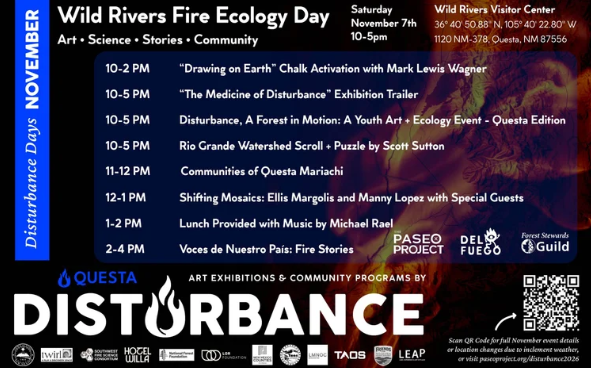
Dress warmly and bring a chair! Location may change due to weather; visit paseoproject.org/disturbance2026 for updates.
EVENT: Screening of the film burn, scar
6 PM Thursday, November 19 at Sky Midtown Cinemas, Santa Fe
Join Films with Backbone, the Forest Stewards Guild, and the Greater Santa Fe Fireshed Coalition 11/19 at Sky Midtown Cinemas to watch the award winning film Burn, Scar about the Hermit's Peak - Calf Canyon Fire. Conversation to follow.